Rolling Options: When to Roll, Close, or Take Assignment
Disclaimer: All ticker prices, premiums, and return calculations shown are examples for educational purposes and reflect market conditions at the time of writing. They are not trade recommendations. Options trading involves significant risk of loss. Past performance of any strategy does not guarantee future results. Consult a licensed financial professional before trading.
Learn when to roll options positions, the difference between rolling up, out, and down, and the psychology traps that make rolling dangerous.
How It Works
You sold the SOFI $17 put when the stock was at $18. Now it's $16.80 with 4 days to expiration and you're staring at assignment. Do you roll, close, or take the shares? The answer depends on three things: can you roll for a credit, is the original thesis intact, and have you already rolled this position before?
Rolling an options position means closing your current contract and simultaneously opening a new one — typically at a different strike, different expiration, or both. It's the primary trade management tool for premium sellers, used to extend winners, defend against losers, or adjust to changing market conditions.
Rolling Out (Same Strike, Later Expiration)
The most common roll extends the expiration while keeping the same strike. You buy back your current short option and sell a new one at a later date. This collects additional time premium because the farther-dated option has more extrinsic value. Rolling out makes sense when your thesis is still intact but the trade needs more time to work. If you sold a $50 put expiring in 10 days and the stock is at $51 (close to your strike), rolling out 30 days collects another round of premium while giving the stock time to move higher.
Rolling Down (Lower Strike, Same or Later Expiration)
Rolling down moves your strike to a lower price — used when a put is being challenged. You buy back the $50 put and sell a $47.50 put at the same or later expiration. This gives you a wider safety margin but typically requires a later expiration to maintain a net credit. Rolling down is defensive — you're accepting a less favorable strike to reduce assignment risk.
Rolling Up (Higher Strike)
Rolling up moves a covered call strike higher when the stock has risen. You buy back the $55 call and sell a $60 call, allowing more upside participation. This costs a debit but can be offset by rolling to a later expiration simultaneously.
The Cardinal Rule: Net Credit Only
Every roll should generate a net credit. If you have to pay (net debit) to roll, the trade thesis is broken — you're throwing good money after bad. A debit roll means the new position starts underwater, making profitability even harder. When you can't roll for a credit, the right action is to close the trade and deploy capital elsewhere.
The Real Edge
Rolling is both the most useful and most dangerous trade management technique. Used correctly, it extends winning streaks and defends challenged positions. Used incorrectly, it turns defined-duration trades into open-ended commitments that compound losses.
The Rolling Trap
The biggest behavioral risk is rolling a losing position indefinitely. Each roll collects a small credit ($50-100), which feels like progress, but the unrealized loss on the position grows larger with each roll. A trader who rolls a $50 put to $47.50, then to $45, then to $42.50 — collecting $300 in credits while sitting on a $1,500 unrealized loss — is fooling themselves. The credits are real, but they're dwarfed by the growing hole in the position.
Good Rolling vs Bad Rolling
Good rolling: your original thesis is intact, the stock is temporarily challenged but fundamentals haven't changed, institutional flow still shows accumulation, and the roll generates a meaningful credit (not just $10). Bad rolling: the stock is in a genuine downtrend, whale flow has turned bearish, earnings disappointed, or you've already rolled 2-3 times. At some point, cutting the loss and moving on is the rational choice — but it never feels that way in the moment.
Rolling Rules to Set in Advance
Set rules before you enter the trade: roll a maximum of 2 times, only for a credit of at least $0.30 per share, never roll past 60 DTE on the new position, and re-evaluate the thesis before every roll. If institutional flow has turned against the stock, don't roll — close. Writing these rules down and following them mechanically prevents emotional decision-making.
When NOT to Roll
Don't roll into earnings — you're adding time to a position that has a binary event coming that could blow through any strike you pick. Don't roll when IV has collapsed — the new premium won't be worth the capital commitment. Don't roll a third time on the same position. If you've rolled twice and it's still underwater, the thesis was wrong. Cut it and move on. The hardest part of rolling is knowing when to stop.
Roll Calculator: Before vs. After
Plug in your numbers to see how rolling changes your breakeven, net credit, and return.
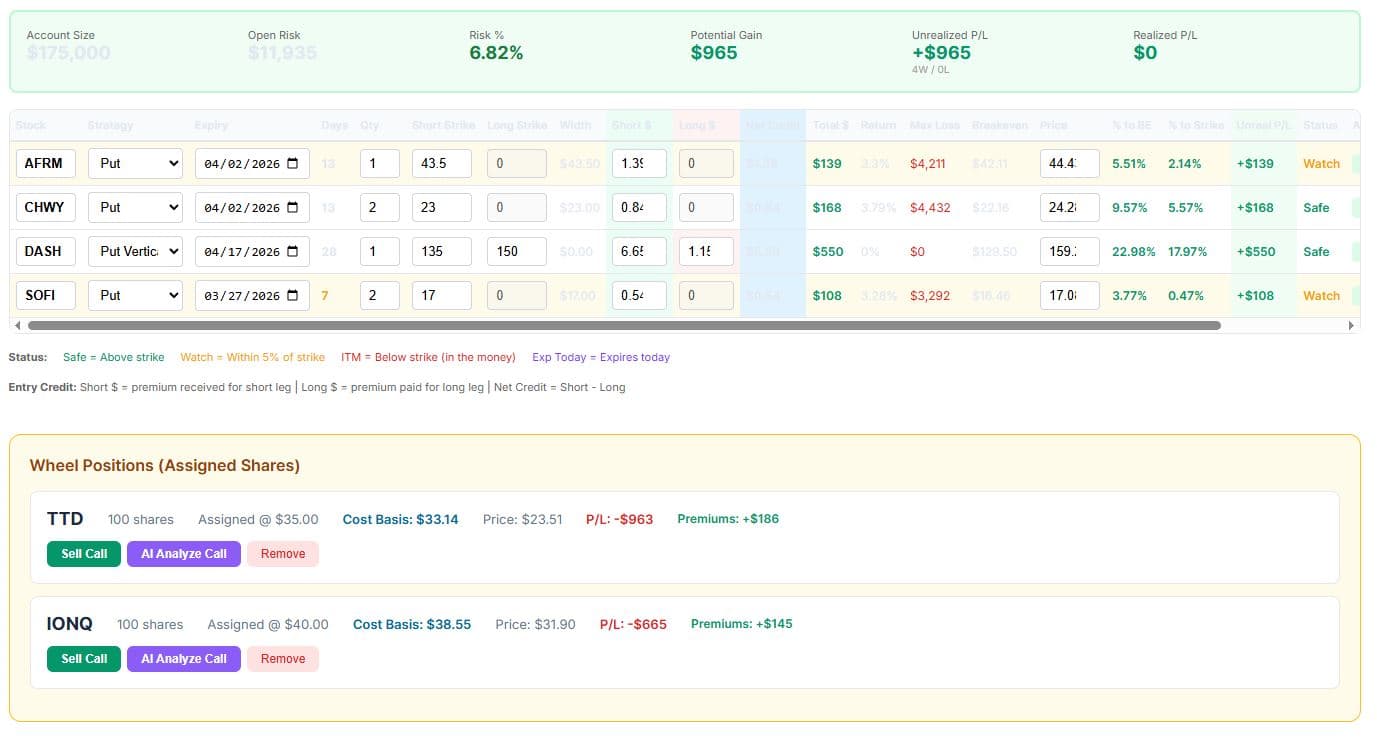
Flow Proof's trade blotter tracks rolls automatically — plus AI that tells you whether to roll, close, or take assignment.
Try the Full Roll Tracker Free →This calculator is for educational purposes only. Results are estimates based on the inputs you provide and do not account for commissions, assignment fees, early exercise, or changes in implied volatility. Not a trade recommendation.
Putting It Into Practice
Flow Proof's AI analysis and whale flow data help you make better rolling decisions by providing objective data on whether the original thesis is still intact.
Thesis Validation Before Rolling
Before rolling a challenged position, check the scanner for the stock's current setup score and IV Rank. If the score has dropped from A to D since you entered, the thesis has deteriorated — rolling is likely throwing good money after bad. If the score is still B or higher and IV Rank is elevated, rolling may be justified.
Whale Flow Check
The whale tracker shows current institutional positioning on your stock. If you're considering rolling a put and you see heavy institutional put buying (bearish flow), that's a red flag — the smart money is positioning for further downside. If you see institutional call buying or sweep activity at support levels, the thesis is more likely intact and rolling makes sense.
AI Analysis "Skip If" as Roll Signal
The AI analysis's "Skip if" condition applies equally to new positions and rolls. If the AI would flag the stock as a skip for a new entry, rolling into it is effectively the same as entering a new bad position. Use the AI analysis as an objective second opinion when emotions are pushing you to roll instead of close.
The Roll Decision Tree
Stock above strike with 7+ DTE? Let it expire worthless. Stock within 2% of strike? Check the whale flow — if institutional flow is still bullish, consider rolling out for more premium. Stock 5%+ below strike? Calculate the roll credit. If you can roll out and down for at least $0.30/share credit and the fundamentals haven't changed, roll once. If you can't get $0.30, close the position and redeploy. Stock 10%+ below strike? Almost always close. The roll credits at that point are too small to matter and you're tying up capital in a broken position.
Related Articles
Free Guides
Start Tracking Institutional Flow
7-day free trial. Full access to whale flow tracking, AI-scored conviction signals, automated paper trading, and the put premium scanner. No credit card required.
Start Free Trial →