How to Roll Options: Complete Guide
Disclaimer: All ticker prices, premiums, and return calculations shown are examples for educational purposes and reflect market conditions at the time of writing. They are not trade recommendations. Options trading involves significant risk of loss. Past performance of any strategy does not guarantee future results. Consult a licensed financial professional before trading.
You sold the SOFI $17 put when the stock was at $18. Now it's $16.80 with 4 days to expiration and you're about to get assigned 200 shares you're not sure you want. Do you roll out and down, take the shares and sell calls, or just close for a loss? I've been in this exact spot — here's the framework I use to decide, plus a free calculator to run the math yourself.
What Does It Mean to Roll an Option?
Rolling is a two-part trade executed simultaneously: you buy to close your existing option position and sell to open a new one. It's not a special order type — it's simply closing one trade and opening another at the same time.
For example, if you sold a $50 put expiring April 18 and the stock has dropped to $51, you might "roll" by buying back the April $50 put and selling a May $48 put. You've moved the position out in time (April → May) and down in strike ($50 → $48).
Why Do Traders Roll Options?
There are several common reasons to roll:
• Avoid assignment: If your short put or call is in the money near expiration and you don't want to be assigned, rolling to a later date buys more time for the stock to recover. • Collect more premium: Rolling out in time lets you collect additional credit, lowering your breakeven and increasing potential profit. • Adjust your strike: If the stock has moved against you, rolling to a different strike can give you a better position. • Extend a winner: If your option is nearly worthless with time left, you can close it early and open a new position to keep generating income. • Manage risk: Rolling down (to a lower strike for puts) or up (higher strike for calls) reduces your exposure.
Types of Rolls
Roll out (in time): Close your current option and open a new one at the same strike but a later expiration. This is the simplest roll — you're buying more time.
Roll down (puts) / Roll up (calls): Close your current option and open a new one at a more favorable strike but same expiration. Useful when a stock has moved against you.
Roll out and down/up: The most common roll in practice — you move both the expiration date and the strike price. This gives you the most flexibility to improve your position.
Diagonal roll: Roll to a different strike AND expiration simultaneously, which is effectively the "roll out and down/up" described above.
When to Roll Options: The Decision Framework
Rolling isn't always the right move. Here's when it makes sense:
• Roll when you can collect a net credit. If rolling costs you money (a debit), you're often better off taking the loss and moving to a fresh trade. The cardinal rule: never roll for a debit unless you have a strong conviction reason. • Roll when your thesis is still intact. If you sold a put on a stock because you liked it at $50 and it dropped to $48 due to broad market weakness (not company-specific bad news), rolling makes sense. If the company just missed earnings badly, take the loss. • Roll with enough time. Don't wait until the day of expiration to decide. The best rolls happen 7-14 days before expiration when there's still enough time value to work with. • Don't roll endlessly. If you've rolled a position 2-3 times and it's still going against you, it's usually a sign the original thesis was wrong. Cut the loss and redeploy capital.
Roll Calculator: Before vs. After
Plug in your numbers to see how rolling changes your breakeven, net credit, and return.
Flow Proof's trade blotter tracks rolls automatically — plus AI that tells you whether to roll, close, or take assignment.
Try the Full Roll Tracker Free →This calculator is for educational purposes only. Results are estimates based on the inputs you provide and do not account for commissions, assignment fees, early exercise, or changes in implied volatility. Not a trade recommendation.
How to Roll a Cash-Secured Put: Step by Step
Let's walk through a real example:
1. You sold the AAPL April 18 $200 put for $3.50 when AAPL was at $210. 2. AAPL drops to $201 with 10 days to expiration. Your put is now worth $5.00 — you're at an unrealized loss of $1.50/share. 3. To roll: Buy to close the April $200 put at $5.00, and simultaneously sell to open the May 16 $195 put for $4.00. 4. Net debit on the roll: $1.00 ($5.00 - $4.00). But your original credit was $3.50, so your net credit across both trades is $2.50. 5. New position: Short the May $195 put. Breakeven is now $192.50 ($195 - $2.50 net credit). You've moved your danger zone down from $196.50 to $192.50.
The trade-off: you've given yourself a better breakeven and more time, but you're now committed to the position for another month.
Rolling Covered Calls
Rolling covered calls follows the same logic but in reverse:
• If your stock rallies past your call strike and you don't want shares called away, roll up and out to a higher strike and later expiration. • If your stock drops and the call is nearly worthless, you can close it early and sell a new one ("roll down") to collect more premium — but this lowers your protection if the stock drops further. • Many covered call sellers roll routinely every month as part of a systematic income strategy.
Tip: If your covered call is deep in the money, check whether rolling for a credit is even possible. Sometimes the best move is to let the shares get called away and redeploy the capital.
Common Rolling Mistakes
• Rolling for a debit: This locks in a loss and extends your risk. Only roll for a credit (or at worst, even) unless you have a very specific reason. • Rolling too late: Waiting until expiration day leaves you with no time value to work with. Start evaluating rolls 7-14 days out. • Rolling a broken thesis: If the fundamental reason you entered the trade is gone (bad earnings, fraud, sector collapse), don't roll — exit. Rolling a fundamentally impaired position just delays the inevitable. • Ignoring opportunity cost: Capital tied up in a rolled position can't be deployed elsewhere. Sometimes taking a small loss and moving to a better setup is the higher-expected-value play. • Rolling down endlessly: Each roll down reduces your premium collected. After 2-3 rolls, the total position may have negative expected value.
Rolling in Practice: How the Pros Do It
Professional premium sellers use rolling as a core part of their workflow:
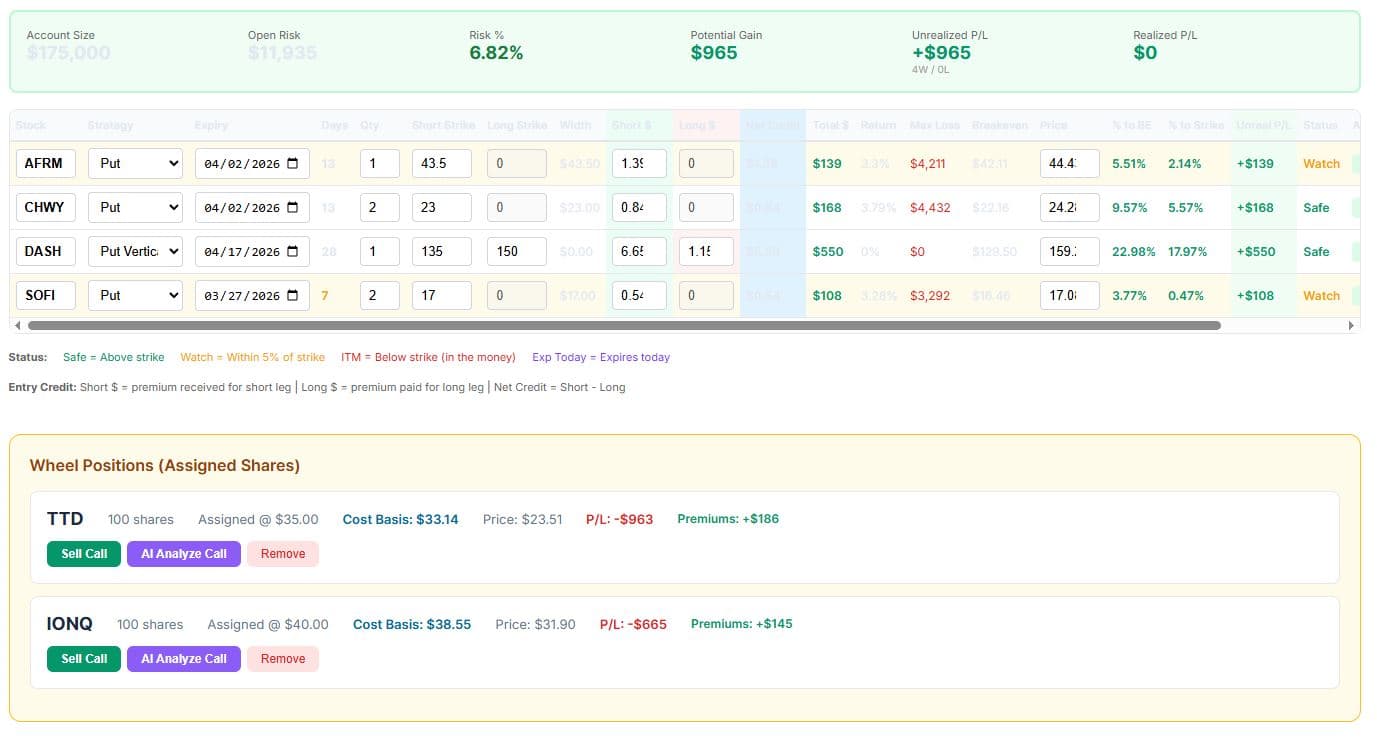
• Set rolling rules in advance: "I'll roll at 14 DTE if the position is challenged" removes emotional decision-making. • Track your cost basis: Keep a running total of credits and debits across all rolls. Your true breakeven is the strike minus total net credit. • Use a trade blotter: Logging every roll with timestamps and P&L helps you identify patterns — which underlyings roll well and which tend to spiral. • Pair with IV analysis: Rolling into a high-IV environment is ideal because you collect more premium on the new position. Rolling when IV is low may not be worth it.
Key Takeaways
Related Research & Tools
Try the Free Put Scanner
Flow Proof's trade blotter tracks rolling positions automatically — see your real breakeven across multiple rolls without manual spreadsheets.
Open Scanner →Frequently Asked Questions
Is rolling options the same as closing and reopening a position?
Mechanically, yes — rolling is just closing one position and opening another at the same time. Most brokers have a "roll" order type that bundles both legs into one trade, which helps with execution and fill prices. But economically, it's the same as two separate trades.
Can you roll options on any broker?
Most major brokers (Schwab, Fidelity, TD Ameritrade/Schwab, Interactive Brokers, Tastytrade) support roll orders as a single transaction. Some mobile-first brokers like Robinhood may require you to execute the two legs separately.
Should I roll in-the-money options or just take assignment?
It depends on your goal. If you want to own the stock, taking assignment is fine. If you want to continue selling premium without buying shares, rolling is the way to go. Compare the net credit from rolling versus the cost basis you'd get from assignment, and factor in opportunity cost.
How many times can you roll an option?
There's no technical limit — you can roll as many times as you want. But practically, if you've rolled 2-3 times and the position is still going against you, your original thesis was likely wrong. Continuing to roll just delays the loss and ties up capital. Set a maximum number of rolls as part of your trade management rules.
What is the best time to roll options?
Most experienced traders evaluate rolling 7-14 days before expiration. This gives you enough remaining time value in the current option to offset the cost of buying it back, while the new option still has meaningful premium. Rolling too early leaves money on the table; rolling too late leaves you with no good options.
How do you roll options positions forward?
Rolling an options position forward (also called an options rollover) means buying back your current contract and selling a new one with a later expiration date. On most brokers you place a single roll order that combines both legs. Aim to roll forward for a net credit so you extend your time in the trade without paying to do it, and lower your breakeven in the process.
What is a good option roll strategy?
A disciplined option roll strategy has three rules: only roll for a net credit, only roll when your original thesis is still intact, and only roll a limited number of times (2-3) before cutting the position. Set your roll trigger in advance — for example, 'roll at 14 DTE if the position is challenged' — so you remove emotion from the decision. Rolling out and down (later date, lower strike) is the most common roll for a challenged put.