The Options Wheel Strategy Explained
Disclaimer: All ticker prices, premiums, and return calculations shown are examples for educational purposes and reflect market conditions at the time of writing. They are not trade recommendations. Options trading involves significant risk of loss. Past performance of any strategy does not guarantee future results. Consult a licensed financial professional before trading.
Learn the wheel strategy: sell puts, get assigned, sell calls. How IV Rank and institutional flow help optimize each phase.
How It Works
The wheel is a three-phase options income strategy that systematically collects premium at every stage: sell cash-secured puts, get assigned shares, sell covered calls, get called away, then repeat. Each phase generates income, and assignment — which most traders fear — is a planned feature rather than a failure.
Phase 1: Sell Cash-Secured Puts
You start by selling a cash-secured put on a stock you'd be happy to own at a lower price. You collect premium upfront and set a strike below the current price. If the stock stays above your strike, you keep the premium and sell another put. If it drops below, you get assigned 100 shares at your strike — but your effective cost basis is the strike minus the premium collected.
Phase 2: Hold Shares and Sell Covered Calls
Once assigned, you own shares at a discount to where the stock was when you initiated the wheel. Now you sell covered calls against your shares, collecting more premium. You choose a call strike above your cost basis so that if called away, you profit on both the shares and the premium. If the stock stays below your call strike, you keep the shares and the premium, then sell another call.
Phase 3: Get Called Away and Restart
When the stock rises above your call strike, your shares are called away at a profit. You've now collected put premium, call premium, and capital gains on the shares. With the cash freed up, you restart the cycle by selling another cash-secured put. This creates a repeating income loop.
Stock Selection Is Everything
The wheel works only on stocks you'd genuinely want to own. If a stock drops 40% and you're assigned, you need to be comfortable holding through the drawdown while selling calls to recover. This means choosing companies with strong fundamentals, institutional support visible in whale flow data, and enough liquidity for tight options spreads.
The Real Edge
The wheel strategy is popular because it generates income from time decay at every stage and turns what most traders consider the worst outcome (assignment) into a strategic advantage.
The Mathematical Edge
At each phase, you're selling options — which means theta decay works in your favor every single day. The volatility risk premium (implied vol > realized vol ~80% of the time) provides a structural edge on both the put-selling and call-selling phases. Over a full cycle, you've collected premium on both sides of the trade plus potential capital appreciation on the shares.
Assignment Is a Feature, Not a Bug
The biggest psychological barrier to premium selling is assignment anxiety. The wheel reframes assignment as the plan: you selected this stock because you want to own it, and you're buying it at a discount (strike minus premium). Once assigned, you immediately begin Phase 2 (covered calls), which generates additional income while you wait for the stock to recover. This mindset shift — from "I got assigned" to "I'm entering Phase 2" — is what makes the wheel psychologically sustainable.
When the Wheel Works Best
The ideal conditions for running the wheel are: elevated IV Rank (50+) so premium is rich on both puts and calls, a stock trading in a range or mild uptrend, no imminent binary events (earnings, FDA decisions) that could cause a gap beyond your strikes, and institutional flow showing accumulation rather than distribution. Running the wheel on a stock with bearish whale flow is a recipe for assignment into a falling knife.
The Wheel Strategy Cycle
Each phase generates income. Assignment isn't a failure — it's the transition to the next income-producing phase.
The wheel strategy generates income at every phase. Phase 1: sell a cash-secured put and collect premium ($150-400/month on a typical $50 stock). Phase 2: if assigned, your cost basis is the strike minus all premiums collected. Phase 3: sell covered calls against your shares to collect even more premium. Phase 4: when shares are called away, you've profited from the put premium, call premiums, and any stock appreciation. Then the wheel restarts.
Put Assignment Analyzer
Your put got assigned — now what? Enter your position details to see your true cost basis and what the AI recommends.
Flow Proof's AI analyzer uses live options chains and whale flow data to recommend the exact covered call strike and expiration — not just estimates.
Try AI Assignment Analyzer Free →This calculator is for educational purposes only. Results are estimates based on the inputs you provide and do not account for commissions, assignment fees, early exercise, or changes in implied volatility. Not a trade recommendation.
Putting It Into Practice
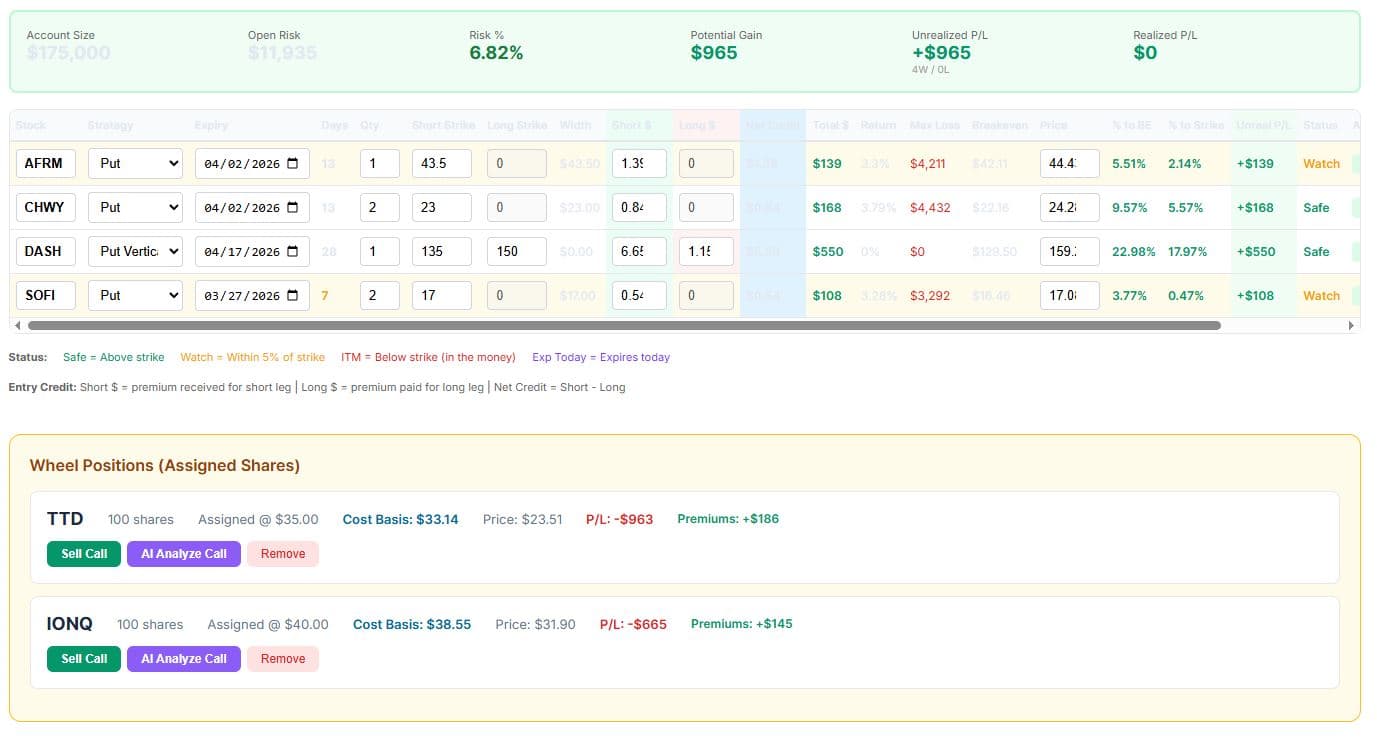
Flow Proof provides the complete toolkit for running the wheel strategy: stock selection via the Put Premium Scanner, entry timing with IV Rank and whale flow, and lifecycle tracking through the trade blotter.
Stock Selection with the Scanner
The Put Premium Scanner evaluates 25 stocks daily across 5 dimensions to find the best wheel candidates. The key metrics are IV Rank (is premium rich?), IV/HV ratio (is the market overpricing risk?), drawdown from recent highs (is the stock at a good entry point?), trend position vs moving average, and relative volume. Stocks scoring A or B are prime wheel candidates.
AI Trade Card for Phase 1 Entry
When you identify a wheel candidate, the AI analysis generates a specific put-selling recommendation: strike, expiration, premium, breakeven, return on capital, and annualized return. It also checks for upcoming earnings and warns if the position has binary event risk — a critical guard for wheel traders.
Lifecycle Tracking in the Trade Blotter
The trade blotter tracks your wheel positions through all three phases. When you're assigned on a put, the blotter shows your cost basis. When you sell calls against those shares, it tracks the combined premium collected. When you're called away, it calculates the total return across the full wheel cycle. This end-to-end tracking lets you measure how the strategy is performing over months and across multiple tickers.
Related Articles
Free Guides
Start Tracking Institutional Flow
7-day free trial. Full access to whale flow tracking, AI-scored conviction signals, automated paper trading, and the put premium scanner. No credit card required.
Start Free Trial →