Selling Options for Income
Disclaimer: All ticker prices, premiums, and return calculations shown are examples for educational purposes and reflect market conditions at the time of writing. They are not trade recommendations. Options trading involves significant risk of loss. Past performance of any strategy does not guarantee future results. Consult a licensed financial professional before trading.
Learn how to sell options for consistent income using theta decay — comparing cash-secured puts, covered calls, and credit spreads with practical risk management.
How It Works
Selling options for income means collecting premium by writing (selling) contracts and profiting as time decay erodes their value. Instead of paying for options and hoping for a big move, you collect money upfront and profit when the stock stays relatively stable — which it does most of the time.
The Three Core Strategies
Cash-secured puts are the entry point: you sell a put option below the current price and collect premium. If the stock stays above your strike, you keep the premium as pure income. If it drops below, you buy shares at a discount. Covered calls work the other direction: you sell calls against shares you own, collecting premium while capping your upside. Credit spreads combine a short and long option to define both your maximum profit and maximum loss.
The Seller's Structural Edge
All three strategies share the same fundamental advantage: time decay (theta) works in your favor every single day. An at-the-money option loses roughly 1-3% of its value per day in the final month before expiration. As a seller, you capture this decay as income. Buyers need the stock to move significantly to overcome this headwind — sellers profit from the passage of time itself.
Income vs Directional Trading
Selling options for income is fundamentally different from directional trading. You're not trying to predict which way a stock will move — you're selecting a range within which you believe the stock will stay, and collecting premium for taking on that risk. Your edge comes from the volatility risk premium (implied vol typically overstates actual movement) and theta decay, not from directional prediction.
The Real Edge
Options selling has been one of the most consistent income strategies over decades because the odds are structurally in the seller's favor. Understanding why this edge exists helps you exploit it more effectively.
The Volatility Risk Premium
Academic research consistently shows that implied volatility exceeds realized volatility approximately 80% of the time. This means options are systematically overpriced — buyers pay more than the actual risk warrants because they're purchasing insurance. As a seller, you're the insurance company collecting premiums that statistically exceed the claims you'll pay out. Over a large sample of trades, this edge compounds into meaningful income.
Probability of Profit
When you sell a 0.20 delta put, there's roughly an 80% probability it expires worthless — meaning you keep the full premium 4 out of 5 times. Even when the trade goes against you, the premium collected provides a cushion. Your breakeven is below your strike by the amount of premium received, so the stock can actually drop past your strike and you still don't lose money until it falls past your breakeven.
When Premium Selling Works Best
The strategy performs best in specific conditions: elevated IV Rank (above 50) means you're selling rich premium. A stable or mildly trending market means fewer adverse moves. Institutional flow showing accumulation (visible in whale data) confirms the stock isn't in a distribution phase. Avoiding binary events (earnings, FDA decisions) within the expiration window eliminates the biggest source of outsized losses.
The Risk Reality
Premium selling wins frequently but small, and loses infrequently but sometimes large. A single gap down on bad earnings can erase months of premium income. This is why position sizing, diversification across uncorrelated names, and risk management rules (max loss per position, portfolio heat limits) are non-negotiable parts of the strategy.
Putting It Into Practice
Flow Proof is purpose-built for premium sellers with a complete workflow from opportunity discovery to trade execution to portfolio management.
The Daily Scanning Workflow
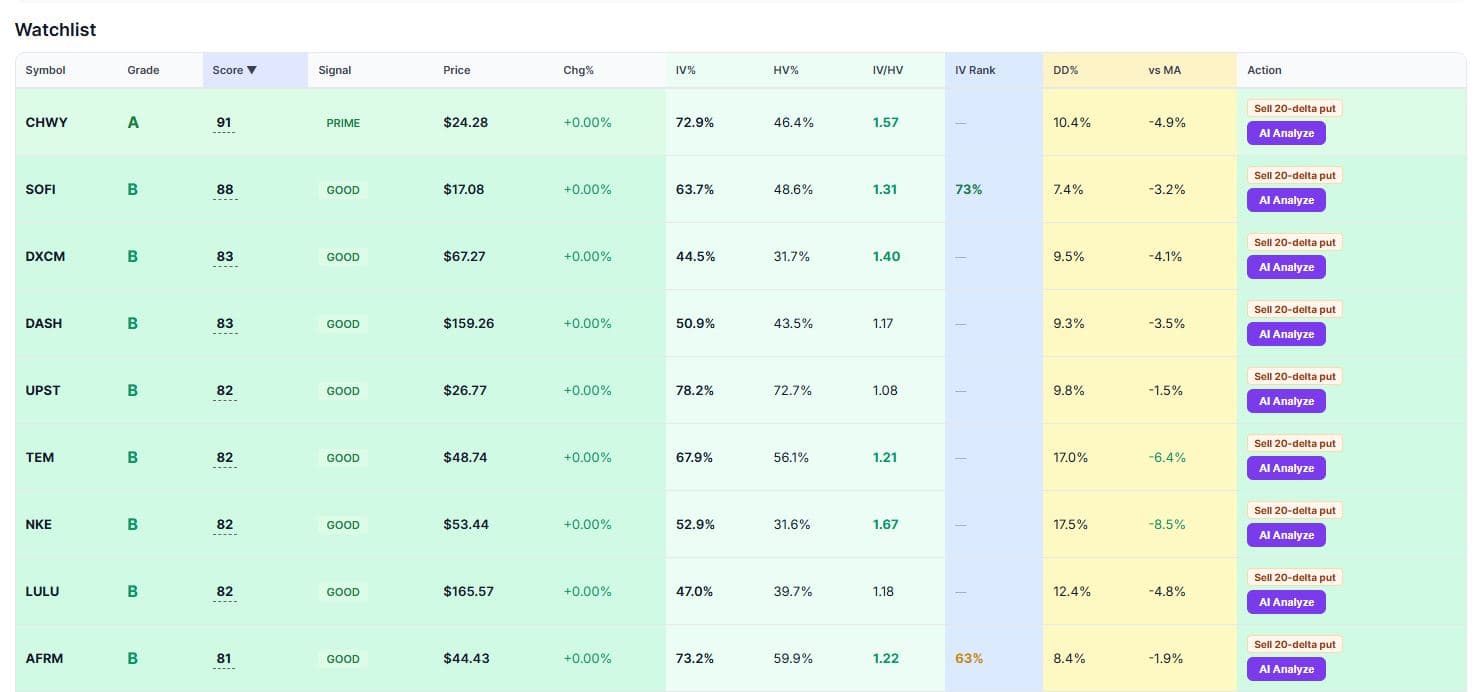
Each day, the Put Premium Scanner evaluates 25 stocks across 5 dimensions: IV Rank (28% weight), drawdown/entry timing (22%), IV/HV premium richness (25%), trend position (15%), and liquidity (10%). The result is a composite score and letter grade for each stock. Sorting by score immediately surfaces the best selling opportunities of the day.
AI-Powered Trade Cards
Click "AI Analyze" on any scanned symbol and Flow Proof generates a specific trade recommendation. The card shows: the exact put strike and expiration, estimated premium per share and per contract, your breakeven price, return on capital, annualized return, and a "Skip if" condition flagging scenarios where the trade should be avoided. This saves hours of manual options chain analysis.
Market Regime Awareness
The dashboard displays the current VIX regime (Low, Normal, Elevated, High, Extreme) and adjusts the recommended approach automatically. In Elevated-to-High VIX, wider delta targets capture rich premium with a larger safety margin. In Low VIX, tighter targets are needed because premium is thinner. This built-in regime adaptation ensures your selling strategy adjusts to market conditions without manual intervention.
Related Articles
Free Guides
Start Tracking Institutional Flow
7-day free trial. Full access to whale flow tracking, AI-scored conviction signals, automated paper trading, and the put premium scanner. No credit card required.
Start Free Trial →